TL/DR:
- Growing eCommerce brands are outgrowing Mailchimp due to its restrictive "pay-per-contact" pricing model and its limitations in handling advanced behavioral automation and real-time data integration.
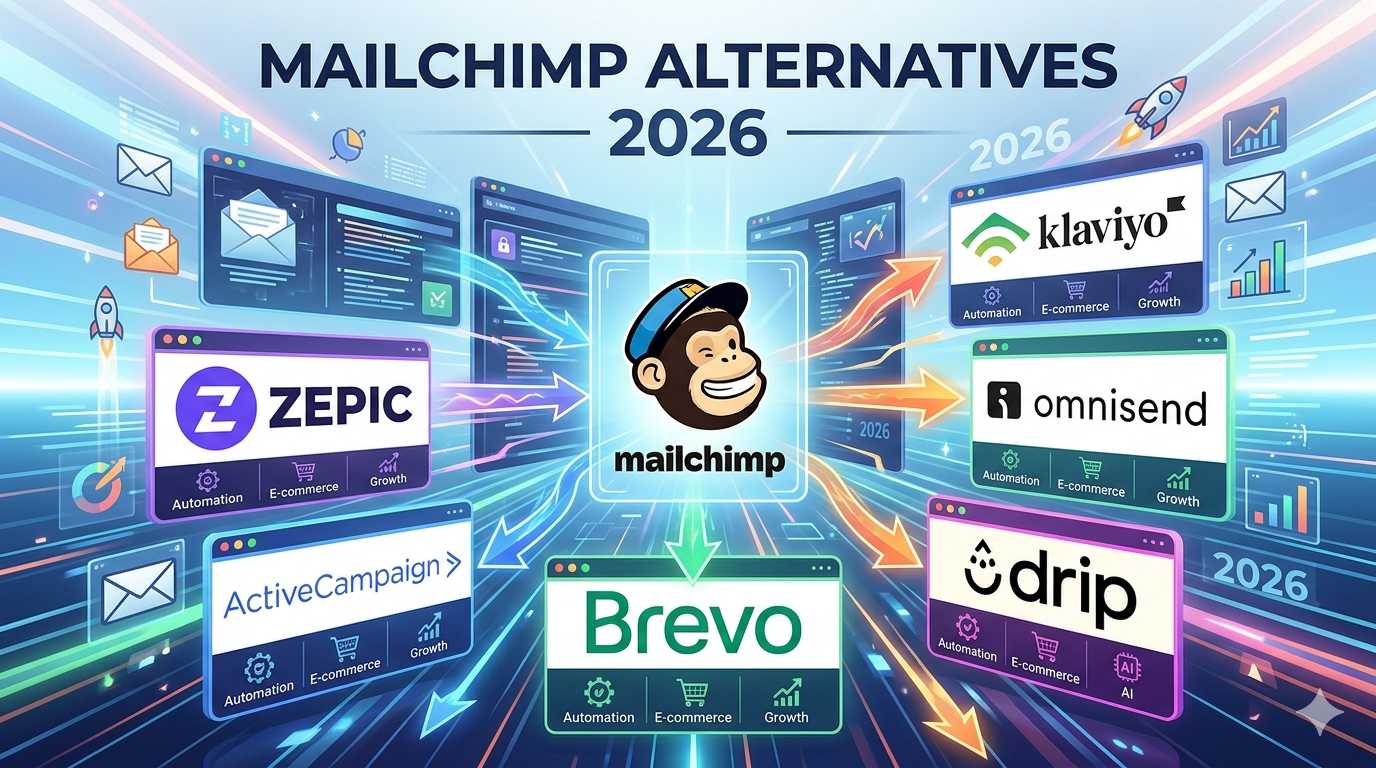
- Leading Mailchimp alternatives include Klaviyo (best for Shopify revenue AI), Omnisend (ideal for multi-channel workflows), ActiveCampaign (top choice for complex visual journeys), Drip (specialized in behavioral triggers), and Brevo (the budget-friendly option for high-volume senders).
- ZEPIC is positioned as a superior "upgrade" rather than just an alternative, offering a native Customer Data Platform (CDP) that unifies Email, SMS, and WhatsApp to eliminate data lag and provide true omnichannel engagement based on active users rather than total contacts.
“Email has an ability many channels don't: creating valuable, personal touches – at scale”
~ David Newmann
Mailchimp ruled the roost for years, with its easy drag-and-drop features and cute monkey mascot. But is that the case in 2026?
Brands are no longer just looking for a "monkey" to send out pretty newsletters; they are looking for sophisticated engines that can power entire customer journeys.
If you feel like you’ve outgrown the yellow background and the winking chimp, you aren't alone. Whether it’s the pricing tiers that feel like they increase every time you blink or the limitations in deep integration, many growing brands are looking for a new home for their marketing automation.
Why eCommerce Brands Are Moving Away from Mailchimp in 2026?
Mailchimp is a fantastic tool for beginners, but for a scaling e-commerce brand, the "pay-per-contact" model can quickly turn into a financial headache. The platform has increased its pricing several times over the past few years, often without adding significant new value. As of today, it can be up to 6x more expensive than its alternatives.
The billing logic also adds to this strain. Costs can quickly start to add up because Mailchimp charges you for every contact, including duplicates across multiple lists, inactive contacts, and unsubscribed users.
Beyond the cost, there is the issue of Data Silos. In 2026, marketing is agentic. You need your email platform to talk to your WhatsApp bot, your Shopify store, and your customer service desk in real-time. If your marketing tool is just an island that sends emails, you're leaving revenue on the table.
Then there's the automation problem. While Mailchimp does offer basic automation tools, it falls short for businesses needing more advanced automation capabilities like behavior-based triggers, multi-step workflows, dynamic landing pages, and advanced A/B testing tools.
For a growing DTC brand juggling abandoned cart flows, post-purchase sequences, win-back campaigns, and flash sale blasts, this "basic" service just doesn't cut it anymore. Modern eCommerce demands a more sophisticated approach, and for many, that's where the friction with Mailchimp begins.
How to Choose The Best Alternative
“You don’t choose email. Email chooses you.”
~ Justine Jordan
Here's a simple framework: start with your pain point.
No two businesses are alike. So before you go platform-hopping, figure out the core benefit you actually need from your next marketing home. Ask yourself:
- Is pricing killing your margins? Then look for platforms with send-based (not contact-based) billing. You should look for a completely different and far more forgiving model that lets you store unlimited contacts and only charges based on how many emails you send
- Is your automation too shallow? If you're manually sending follow-ups that should have been triggered two days ago, you need a platform with deep behavioral workflows. Look for multi-step, conditional automations that respond to what your customers do, not just who they are.
- Are you channel-blind? Email alone doesn't close the loop anymore. Your platform should connect with, or ideally include, SMS, WhatsApp, and push notifications. If it can't talk to your Shopify store, your support desk, and your ad campaigns simultaneously, it's already behind.
- Do you need better data? A platform is only as smart as the data it runs on. If you're segmenting based on nothing more than "opened last email," you're operating in the dark.
Keep these pain points in mind as you read through the alternatives below. Think of it less like shopping for software and more like hiring a long-term marketing partner that grows with you.
Quick Comparison: Mailchimp vs. The Alternatives
Email is a push channel, so we need to push it to work harder
~ Kath Pay
Choosing the right platform depends on your brand's specific growth stage and technical needs. Here’s how the top contenders stack up in 2026:
| Platform |
Pricing Model |
Starting Price (Est.) |
Best For |
Standout Feature |
| ZEPIC |
Active User-based |
Starts at $30/month |
Data-driven Brands |
Native CDP, 50+ Integrations, Advanced AI CapabilitiesP |
| Mailchimp |
Contact-based |
~$13/month |
Beginners |
Intuitive UI & Templates |
| Klaviyo |
Contact-based |
$20/month |
Shopify Brands |
Advanced Revenue AI |
| Omnisend |
Contact-based |
$16/month |
Multi-channel SMBs |
eCommerce-ready Workflows |
| ActiveCampaign |
Contact-based |
$15/month |
Complex Automation |
Visual Journey Builder |
| Brevo |
Send Volume |
$9/month |
Budget-conscious |
Unlimited Contacts |
| Drip |
Contact-based |
$39/month |
Personalization-heavy |
Behavioral Trigger Engine |
Top Mailchimp Alternatives for Scaling Brands
When evaluating a new email marketing platform, you need to look at ease of use, automation sophistication, and integration depth. Here are the contenders currently leading the pack:
ZEPIC
ZEPIC is an email marketing platform that redefines emails with an AI-first approach built for modern marketers. The platform unifies customer data, attributes revenue across every email touchpoint, and helps you treat email as a high-performing revenue channel.
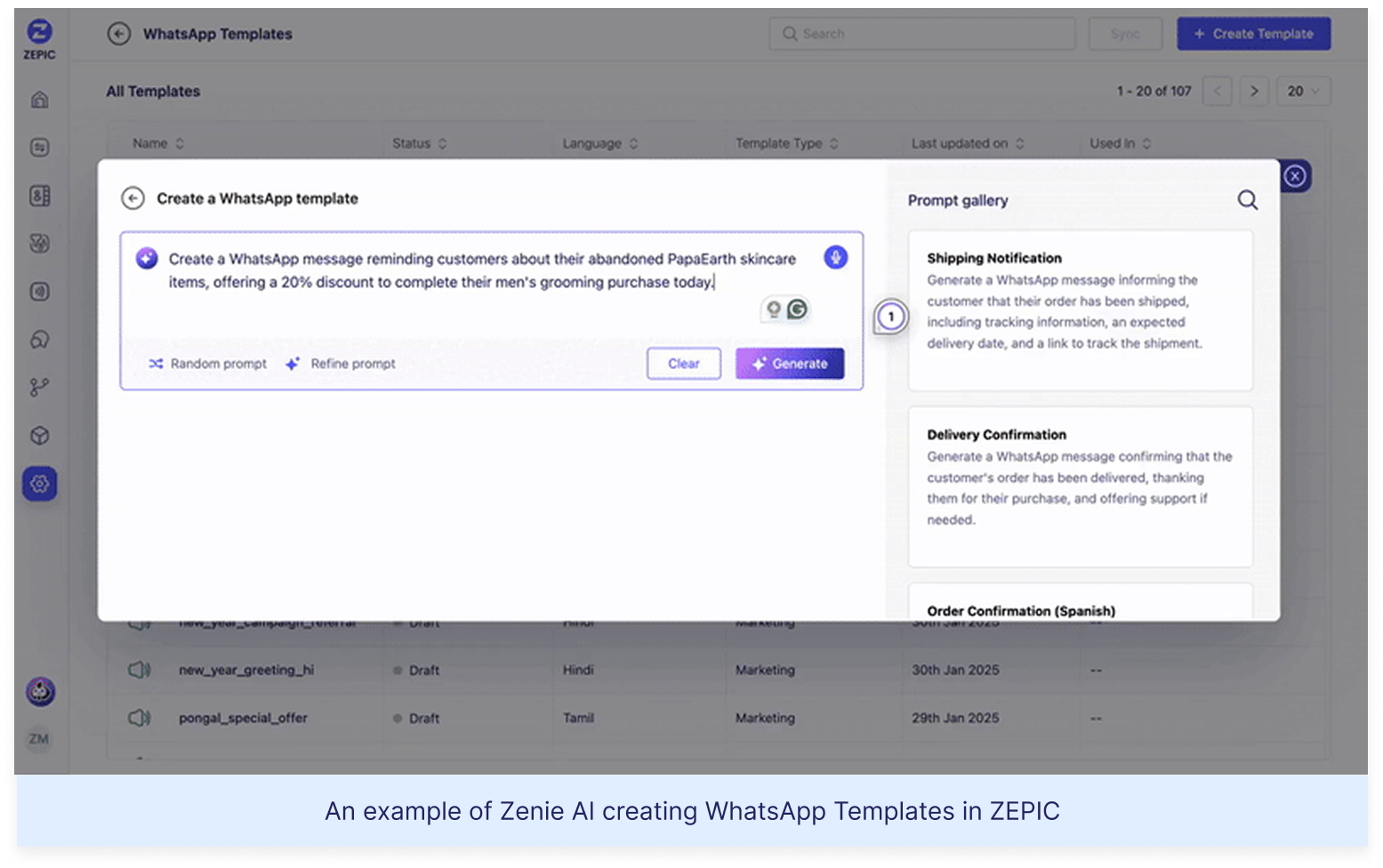
With Zenie, ZEPIC's AI assistant, marketers can instantly generate campaigns, create dynamic segments, and personalize content at scale without any technical overhead. From automated welcome flows and re-engagement journeys to advanced Shopify metafield mapping, ZEPIC gives email marketers everything they need to launch smarter, revenue-driving email programs.
- The Edge: ZEPIC features a built-in Customer Data Platform (CDP) at no extra cost, providing unified customer profiles and real-time data activation. Its strong omnichannel capabilities natively integrate Email, WhatsApp, and Instagram, while AI-powered predictive segmentation significantly reduces campaign creation time.
- The Catch: Certain features, like native A/B testing and smart feeds, are currently still in development or rolling out soon.
- Best for: E-commerce stores, travel & hospitality brands, and businesses that need deep data-driven email automation seamlessly integrated with omnichannel marketing.
Klaviyo
If you run a Shopify store, Klaviyo is probably already sitting in your browser history. It's the name that comes up in nearly every eCommerce Slack community, and for good reason.
Klaviyo is purpose-built for online retail. It pulls in your store data (purchase history, browsing behavior, cart activity, customer lifetime value) and uses all of it to power highly targeted campaigns.
Its flows library is one of the most comprehensive in the industry: abandoned cart, browse abandonment, post-purchase, win-back, and sunset flows are all available out of the box. The platform also does a lot of thinking for you with its new Klaviyo's AI suite (K: AI) that handles predictive analytics, send-time optimization, and subject line generation.
- The Edge: Their predictive analytics can tell you when a customer is likely to buy again or when they are about to churn. Its "flows" are built specifically for the eCommerce lifecycle.
- The Catch: It’s powerful, but the learning curve is steep. Klaviyo's pricing also scales with your contact list. For 2,500 contacts, you're looking at $45/month. At 10,000 contacts, that climbs to $150/month. For enterprise-level lists, the bill can become substantial.
- Best for: Mid-to-large eCommerce brands on Shopify or WooCommerce that want revenue-driven automation and are willing to invest accordingly.
Omnisend
Omnisend was built specifically for eCommerce and not retrofitted for it, not adapted from a general-purpose tool. That origin story matters because the product reflects it in every feature. Beyond email, Omnisend includes SMS, web push notifications, and Google and Facebook audience sync from one dashboard. Its pre-built automation workflows (cart abandonment, order confirmation, shipping updates, review requests) are ready to go in minutes, not hours.
- The Edge: Omnisend allows you to combine Email, SMS, and Web Push into a single workflow. For instance, if a customer doesn't open an abandoned cart email within four hours, Omnisend can automatically send a follow-up SMS.
- The Catch: While Omnisend is a powerhouse for SMS and Push, its WhatsApp capabilities in 2026 still feel a bit like an add-on. If your brand relies heavily on two-way conversational commerce or AI-driven WhatsApp support, you might find yourself looking for third-party integrations.
- Best for: Growing DTC brands that want to move beyond email into SMS and Push without a complex technical setup.
- ActiveCampaign
If Klaviyo is built for revenue and Omnisend is built for simplicity, ActiveCampaign is built for complexity. Its visual automation builder is genuinely best-in-class. You can create branching workflows based on purchase history, page visits, email engagement, form submissions, deal stages, and custom events.
It also includes a built-in CRM, which means your sales and marketing teams can operate from the same platform without duplicating contact records or losing conversation history. That's a meaningful operational win, especially for brands that blend D2C selling with B2B wholesale.
- The Edge: Its visual automation builder is arguably the best in the business. You can see exactly how a customer moves through a journey, including "Goals" that pull them out of a sequence once they take a specific action. It also has a built-in CRM that’s great if your eCommerce brand also has a B2B or "high-touch" sales component.
- The Catch: It can be overwhelming. There are so many features that small teams often find themselves paying for "power" they never actually use.
- Best for: Sophisticated marketers who need deep CRM integration and complex, multi-path customer journeys.
Drip
Drip focuses on behavioral segmentation and personalization for e-commerce. The platform lets you build hyper-specific audience segments based on almost any combination of data: browsing behavior, purchase frequency, product categories, average order value, and engagement history. Where many tools offer segmentation as a feature, Drip treats it as a core philosophy.
Its automation workflows are visual and eCommerce-focused, with pre-built sequences for cart recovery, post-purchase nurturing, and customer win-back. It also integrates natively with Shopify, WooCommerce, and Magento, pulling in real-time product and order data to keep your campaigns contextually relevant.
- The Edge: Drip’s "Workflows" can create incredibly granular paths. For example, sending a specific "VIP" discount only to users who have visited your "Best Sellers" page three times in the last week but haven't purchased. It’s about hitting the right person with the right offer at the exact moment they’re considering it.
- The Catch: Because Drip is so data-centric, the interface can feel a bit daunting for those used to Mailchimp's "fluffy" UI. To get the most out of it, you need to have your tracking scripts and data hygiene in tip-top shape.
- Best for: High-growth eCommerce brands that prioritize personalization and have the data to back up complex behavioral triggers.
Brevo
Brevo (formerly Sendinblue) made a smart bet: charge for emails sent, not contacts stored. In a world where most eCommerce brands accumulate contacts far faster than they email them, this pricing model is a genuine competitive advantage.
You can store an unlimited number of contacts and only pay based on sending volume. That means a brand with 80,000 contacts but a biweekly email cadence pays dramatically less than they would on Mailchimp. For businesses with large but occasionally-messaged lists, Brevo can cut costs significantly.
Beyond pricing, Brevo has evolved into a solid all-in-one platform. It covers email, SMS, WhatsApp campaigns, a built-in CRM, landing pages, and even live chat. The automation builder is capable, if not as deep as ActiveCampaign's, and the template library is clean and well-organized.
- The Edge: Brevo doesn't care if you have 5,000 or 500,000 contacts; they only charge you for the volume of emails you actually hit "send" on. This makes it the most budget-friendly heavyweight for brands with massive, dormant lists that they only want to engage occasionally.
- The Catch: The template gallery and creative tools aren't quite as "slick" or trend-forward as Klaviyo or Mailchimp. You might spend more time on design if you want that high-end DTC aesthetic.
- Best for: High-volume senders and budget-conscious brands that need a solid all-in-one tool without the per-contact price gouging.
The ZEPIC Perspective: Why Switching Silos Isn't Enough
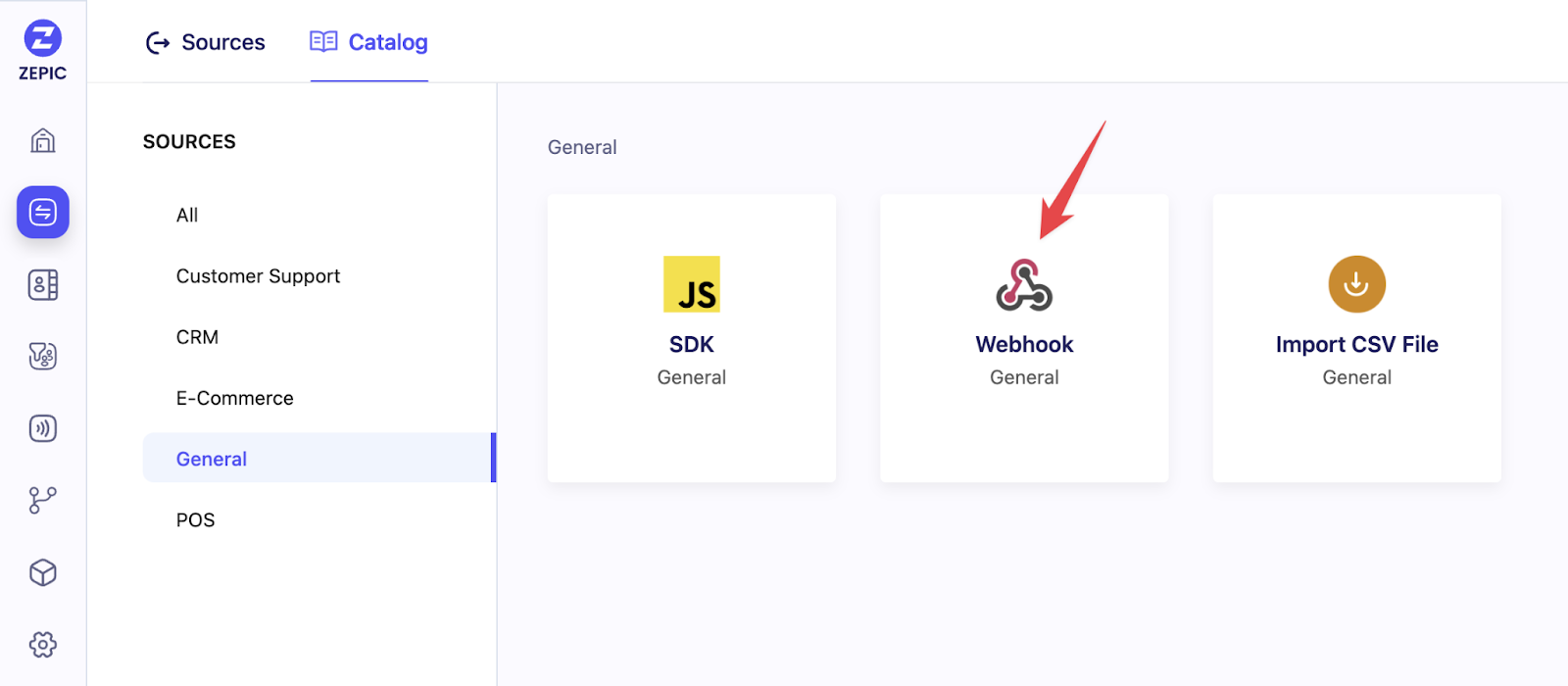
If you’ve spent any time in the eCommerce trenches, you know the "Migration Headache." You export your CSVs, re-upload your tags, rebuild your welcome flows, and six months later, you realize you've just moved your problems from a yellow dashboard to a blue one.
The real issue in 2026 isn't that Mailchimp is "bad". The tool, like many of its alternatives, was built as a single-channel tool trying to act like a platform. When your email tool doesn't natively know what your WhatsApp bot said an hour ago, or that a customer just complained on Instagram, your "automation" isn't actually automatic.
This is why we built ZEPIC. We didn't want to build another "alternative"; we wanted to build the upgrade.
ZEPIC is a Customer Data Platform (CDP) first and a marketing engine second. This means:
- No More Data Lag: When someone buys on Shopify, your "Abandoned Cart" sequence stops across Email, SMS, and WhatsApp instantly.
- True Omnichannel: You aren't "bolting on" WhatsApp. It’s a native part of the journey, allowing for two-way AI-powered conversations that close sales while you sleep.
- Unlimited Scale: Because we focus on Active Users, you aren't penalized for having a massive database. You're rewarded for having an engaged one.
Final Thoughts
In 2026, the brands that win aren't the ones with the prettiest newsletters. They are the ones who use data to treat every customer like an individual. If your current platform feels like a "silent partner" that only talks when you tell it to, it’s time for a change.
Whichever platform you choose, the goal is the same: Stop blasting and start conversing.
Is your brand ready for a marketing engine that actually speaks "data"? Book a demo to explore how ZEPIC unifies your eCommerce world today.
Frequently Asked Questions
Which Mailchimp alternative is best for small businesses?
For small businesses with limited budgets, Brevo and MailerLite are strong options due to their generous free tiers and send-based pricing. They allow you to grow your list without immediately incurring high costs tied to contact volume.
Can I migrate my Mailchimp data easily?
Yes. Most platforms like Klaviyo, Omnisend, and ZEPIC offer one-click import tools that move your contacts and tags seamlessly. However, automation workflows typically need to be rebuilt to align with the new platform’s logic and capabilities.
How does ZEPIC handle the "contact-based" pricing trap?
Instead of charging for every stored contact, including inactive ones, ZEPIC focuses on the value generated from engaged customers. This approach ensures that your budget is spent on users who actively interact with your brand, making pricing more aligned with performance.
How hard is it to switch from Mailchimp?
Switching is relatively straightforward. Most platforms provide import tools for contacts and tags, but you will need to rebuild key automation workflows such as welcome sequences. Plan for a one to two week transition period to migrate, test, and optimize your setup.
Is there a free Mailchimp alternative?
Yes. Platforms like Brevo and MailerLite offer free plans with useful features for early-stage businesses. However, as your ecommerce brand grows and you require advanced automation and segmentation, you will likely need to upgrade once your list exceeds around 2,000 contacts.
Desperate times call for desperate Google/Chat GPT searches, right? "Best Shopify apps for sales." "How to increase online sales fast." "AI tools for ecommerce growth."

Been there. Done that. Installed way too many apps.
But here's what nobody tells you while you're doom-scrolling through Shopify app reviews at 2 AM—that magical online sales-boosting app you're searching for? It doesn't exist. Because if it did, Jeff Bezos would've bought (or built!) it yesterday, and we (fellow eCommerce store owners) would all be retired in Bali by now.
Growing a Shopify store and increasing online sales isn’t easy—we get it. While everyone’s out chasing the next “revolutionary” tool/trend (looking at you, DeepSeek), the real revenue drivers are probably hiding in plain sight—right there inside your customer data.
After working with Shopify stores like yours (shoutout to Cybele, who recovered almost 25% of their abandoned carts with WhatsApp automation), we’ve cracked the code on what actually moves the needle.
Ready to stop app-hopping and start actually growing your sales by using what you already have? Here are four fixes that will get you there!
Fix #1: Convert abandoned carts instantly (Like, actually instantly)
The Painful Truth: You're probably losing about 70% of your potential sales to cart abandonment. That's not just a statistic—it's real money walking out of your digital door. And looking for yet another Shopify app for abandoned cart recovery isn't going to fix it if you're not getting the fundamentals right.
The Quick Fix: Everyone knows you need multi-channel recovery that hits the sweet spot between "Hey, did you forget something?" and "PLEASE COME BACK!" But here's the reality—most recovery apps are a one-trick pony. They either do email OR WhatsApp, not both. And don't even get us started on personalizing offers based on cart value—that usually means toggling between three different dashboards while praying your apps talk to each other.
Enter ZEPIC: This is where we come in. With ZEPIC's automated Flows, you can:
Launch WhatsApp recovery messages (with 95% open rates!)
Set up perfectly timed email sequences (or vice versa)
Create personalized recovery offers not just on cart value but based on your customer’s behavior/preferences
Track and optimize everything from one dashboard
Fix #2: Reactivate past customers today
The Painful Truth: You're probably losing about 70% of your potential sales to cart abandonment. That's not just a statistic—it's real money walking out of your digital door. And looking for yet another Shopify app for abandoned cart recovery isn't going to fix it if you're not getting the fundamentals right.
The Quick Fix: Everyone knows you need multi-channel recovery that hits the sweet spot between "Hey, did you forget something?" and "PLEASE COME BACK!" But here's the reality—most recovery apps are a one-trick pony. They either do email OR WhatsApp, not both. And don't even get us started on personalizing offers based on cart value—that usually means toggling between three different dashboards while praying your apps talk to each other.
Enter ZEPIC: This is where we come in. With ZEPIC's automated Flows, you can:
Launch WhatsApp recovery messages (with 95% open rates!)
Set up perfectly timed email sequences (or vice versa)
Create personalized recovery offers not just on cart value but based on your customer’s behavior/preferences
Track and optimize everything from one dashboard
Offering light at the end of the tunnel is Google’s Privacy Sandbox which seeks to ‘create a thriving web ecosystem that is respectful of users and private by default’. Like the name suggests, your Chrome browser will take the role of a ‘privacy sandbox’ that holds all your data (visits, interests, actions etc) disclosing these to other websites and platforms only with your explicit permission. If not yet, we recommend testing your websites, audience relevance and advertising attribution with Chrome’s trial of the Privacy Sandbox.
Top 3 impacts of the third-party cookie phase-out
Who’s impacted
How
What next
Digital advertising and
acquisition teams
Lack of cookie data results in drastic fall in website traffic and conversion rate
Review all cookie-based audience acquisition. Sign up for Chrome’s trial of the Privacy Sandbox
Digital Customer Experience
Customers are not served relevant, personalised experiences: on the web, over social channels and communication media
Multiply efforts to collect first-party customer data. Implement a Customer Data Platform
Security, Privacy and Compliance teams
Increased scrutiny from regulators and questions from customers about data storage and usage
Review current cookie and communication consent management, ensure to align with latest privacy regulations




%201.png)