TLDR
- Choosing the right email marketing platform for Shopify directly impacts growth, automation, and long-term scalability
- Many tools look similar upfront, but differ significantly in data depth, automation, and pricing as you scale
- Strong Shopify integration should include real-time sync of orders, products, and customer behavior
- Behavior-triggered automation, like cart abandonment and post-purchase flows, is essential for revenue generation
- Advanced segmentation based on purchase history and behavior enables better targeting and personalization
- Dynamic product content helps send emails tailored to what customers actually viewed or purchased
- Revenue attribution is critical to understand which campaigns are driving actual Shopify sales
- Omnichannel capabilities across email, WhatsApp, and other channels are becoming increasingly important
- ZEPIC stands out for AI-driven automation, built-in CDP, and true omnichannel functionality
- Klaviyo, Omnisend, and Mailchimp each serve different stages, from advanced brands to beginners, with tradeoffs in cost, depth, and scalability
Choosing an email marketing platform for your Shopify store is a decision that has long-term implications for how you engage with your customers and scale your business.
While many platforms offer the basics, the differences become clear as your needs evolve. You may need deeper data integration, more flexible automation, or better visibility into what is actually driving revenue.
Not every tool is built to handle those demands, and switching platforms later can be both time-consuming and costly. That is why it is important to get this decision right from the start.
In this guide, we compare the most widely used email marketing platforms for Shopify brands in 2026, focusing on the features and capabilities that directly impact performance so you can choose a solution that grows with your business.
What Shopify Brands Actually Need From an Email Marketing Platform
- Real Shopify data sync: Orders, products, browsing behavior, purchase history, and customer tags should sync natively
- Behavior-triggered automation: Flows that fire based on what shoppers actually do: browse a product, abandon a cart, make their first purchase, go quiet for 60 days
- E-commerce-specific segmentation: Segments like "bought product A but not B," "spent over $150 in the last 90 days," or "viewed a collection three times without buying."
- Dynamic product content: Emails that auto-populate with the items a customer actually looked at or left in their cart
- Revenue attribution: Reporting that tells you which emails drove real Shopify sales, not just open rates
- Omnichannel support: The ability to follow up on email with WhatsApp, Instagram, or email from the same platform, without adding another tool
- Pricing that scales fairly: A model that does not punish you for growing your list or gate essential features behind expensive plan upgrades
Quick Comparison: Shopify Email Marketing Platforms in 2026
| Feature |
ZEPIC |
Klaviyo |
Omnisend |
Mailchimp |
|
| Shopify data sync |
Deep — orders, products, behavior, metafields |
Strong — orders, products, events |
Good — orders, products, basic events |
Basic — orders and contacts only |
| Shopify metafield support |
Yes | No | No | No |
| Real-time sync |
Yes | Yes | Yes | Partial |
| Product catalog sync |
Yes | Yes | Yes | Yes |
|
| Cart abandonment |
Yes | Yes | Yes | Yes (paid plans) |
| Browse abandonment |
Yes | Yes | Yes | No |
| Post-purchase flows |
Yes | Yes | Yes | Limited |
| Win-back / re-engagement |
Yes | Yes | Yes | Limited |
| Welcome series |
Yes | Yes | Yes | Yes |
| Multi-step journey builder |
Yes — visual, omnichannel |
Yes — email and SMS only |
Yes — email and SMS only |
Basic |
| Behavior-triggered flows |
Yes — real-time | Yes — real-time | Yes | Limited |
|
| Purchase-history segmentation |
Yes | Yes | Yes | Limited |
| AI-powered / predictive segmentation |
Yes | Yes | No | No |
| Real-time segment updates |
Yes | Yes | No | No |
| Custom data objects |
Yes | Yes | No | No |
|
| AI campaign creation (copy + design) |
Yes — Zenie AI, end-to-end |
Partial — copy assist only |
Partial — subject lines only |
Partial — copy assist only |
| AI send-time optimization |
Yes | Yes | No | Yes |
| Predictive analytics |
Yes | Yes | No | No |
|
| Email |
Yes | Yes | Yes | Yes |
| SMS |
Coming soon | Yes | Yes | Yes |
| WhatsApp |
Yes | Yes | No | No |
| Instagram DM automation |
Yes | No | No | No |
| Web push notifications |
No | No | Yes | No |
|
| Built-in CDP |
Yes — included | Paid add-on | No | No |
| Revenue attribution |
Yes | Yes | Yes | Limited |
| Unified customer profiles |
Yes | Paid add-on | No | No |
| A/B testing |
In development | Yes | Yes | Yes |
|
| Starting price |
$23/month | $45+/month | $16/month | $19/month |
| Free plan available |
Free trial | Free trial | Yes | Yes |
| Pricing model |
Pay-as-you-go | Contact-based | Contact-based | Contact-based |
| Long-term contracts required |
No | No | No | No |
| Setup complexity |
Low | Medium | Low | Low |
|
| Best For |
Shopify brands wanting AI, omnichannel, and a built-in CDP in one platform |
Established stores focused on email and SMS performance |
Small to mid-sized stores wanting fast, simple automation |
Early-stage stores with basic newsletter and campaign needs |
The 4 Best Email Marketing Platforms for Shopify Brands in 2026
1. ZEPIC: Best Overall for Shopify Brands
ZEPIC is an AI-first email marketing platform built specifically for e-commerce brands, and the Shopify integration reflects that from the ground up. Unlike tools that connect to Shopify through a basic API, ZEPIC supports native Shopify metafield mapping. That means you can pull custom product attributes, collection tags, customer notes, and store-specific data fields directly into your email personalization logic, without a developer or extra setup.
The platform includes a built-in Customer Data Platform (CDP) at no additional cost. Every customer interaction, purchase, browse session, and channel touchpoint is unified into a single profile. Segmentation in ZEPIC is built on complete, real-time data, so when you create a segment such as "high-value customers who bought in the last 30 days but have not opened an email in two weeks," ZEPIC is working from the full picture.
What makes ZEPIC stand out specifically for Shopify:
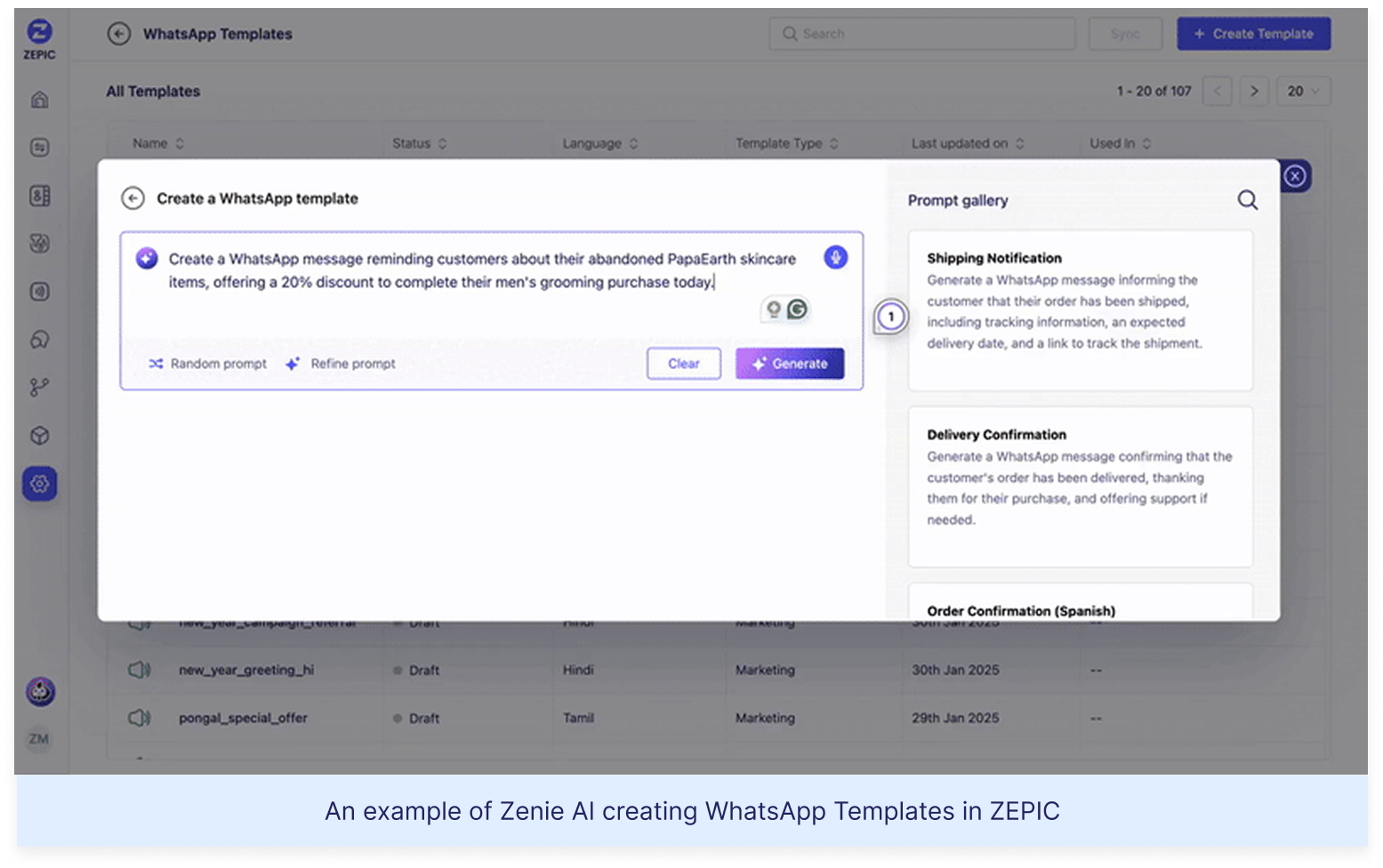
- Zenie AI handles end-to-end campaign creation. You can generate subject lines, email body copy, and audience segments using natural language prompts, reducing the time from brief to live campaign significantly
- Visual journey builder lets you create multi-step customer flows that combine email, WhatsApp, and Instagram in a single canvas. Your post-purchase sequence, win-back flow, and cart abandonment series do not need to live in three separate tools
- Instagram DM automation is a feature most email platforms do not offer, ZEPIC lets you trigger automated DM flows based on Instagram comments or story replies, then use those interactions to drive email signups or direct Shopify purchases
- Revenue attribution is built in, with clear reporting on which specific emails and automation flows generated actual Shopify revenue
Pricing: Flexible, pay-as-you-go with no long-term contracts required. Starts at $23/month with a free trial available.
Best for: Shopify brands at any stage that want deep ecommerce automation, omnichannel reach, and AI-powered personalization in one platform without paying extra for a CDP.
Honest limitations: A/B testing is still in development. Smart Feeds is coming soon.
2. Klaviyo: A Good Fit, Premium Price Tag
Klaviyo’s Shopify integration is reliable, real-time, and deep. Data syncs consistently, and the pre-built flow library covers the core e-commerce sequences most brands need: welcome series, cart abandonment, browse abandonment, post-purchase, and win-back.
Cost and data infrastructure are the two things that might make Klaviyo a difficult choice for Shopify brands. The pricing model is contact-based, meaning that as your list grows, your bill grows proportionally. CDP functionality comes as a separate paid add-on in Klaviyo. Data transformation capabilities are also limited for brands with complex store architectures or multiple data sources.
What works well for Shopify brands:
- Deep Shopify integration with reliable real-time data sync across orders, products, and events
- Strong library of pre-built ecommerce flows ready to deploy out of the box
- Good predictive analytics for purchase likelihood and churn risk
- Solid A/B testing across subject lines, content blocks, and send timing
- Dynamic product recommendation blocks pulling directly from your Shopify catalog
Pricing: Contact-based, starting at $45/month for combined email and SMS. No pay-as-you-go option. Costs scale steeply for larger lists.
Best for: Established Shopify brands with dedicated marketing budgets focused primarily on email and SMS performance.
Honest limitations: CDP functionality requires a paid add-on. Becomes expensive for fast-growing stores. No omnichannel support for Instagram.
3. Omnisend: Entry Point for Smaller Shopify Stores
Omnisend is a good choice for small to mid-sized Shopify brands that want to get up and running quickly without complex onboarding. The Shopify connection is straightforward with pre-built automation templates ready to activate, and the interface is approachable for marketers who are setting up their first email flows.
But you might have to compromise on depth and scalability. Omnisend does not have a built-in CDP. Segmentation is rule-based rather than AI-driven, which works for simpler use cases but limits how granular you can get with targeting. For brands that need advanced personalization, multi-channel customer journeys, or predictive segmentation, Omnisend will start to feel limiting fairly quickly.
What works well for Shopify brands:
- Fast setup with plug-and-play ecommerce automation templates for cart recovery, welcome flows, and browse abandonment
- Email, SMS, and web push notifications available in one platform
- Good drag-and-drop email builder with a Shopify product picker
- Affordable pricing with a free plan for low-volume sending
- Clean reporting on campaign performance and automation results
Pricing: Free plan available with send limits. Standard plan from $16/month. Pro plan from $59/month.
Best for: Small to mid-sized Shopify stores that want simple, fast email and SMS automation at an accessible price point.
Honest limitations: No AI-driven personalization. Limited advanced segmentation. Not suited for complex omnichannel automation or large-scale data-driven campaigns.
4. Mailchimp: Familiar Name, Limited Ecommerce Depth
Mailchimp is one of the most recognized email tools in the market and works well for simple email programs. Its interface is clean, its template library is extensive, and its free plan is genuinely generous for low-volume senders. For Shopify brands with basic needs, it is a workable starting point.
For e-commerce automation, however, Mailchimp is not purpose-built. The Shopify integration is more basic than ecommerce-first platforms, advanced behavioral automation requires higher-tier paid plans, and the segmentation lacks the purchase-history depth that Shopify brands rely on for lifecycle campaigns. Brands that grow beyond simple newsletters tend to migrate away from Mailchimp fairly quickly.
What works well for Shopify brands:
- Beginner-friendly with a gentle learning curve
- Strong template library with good branding customization options
- Good for brands whose email program is primarily newsletters and promotional sends
- Free plan available for small lists
- AI-assisted content generation for subject lines and copy
Pricing: Free plan with sending limits. Paid plans from $19/month, contact-based with add-ons required for advanced features.
Best for: Early-stage Shopify stores or brands whose email needs are primarily newsletters and simple campaigns rather than behavior-driven automation.
Honest limitations: E-commerce-specific automation is significantly less robust than dedicated platforms. Advanced lifecycle flows require costly plan upgrades.
Run Smarter Email for Your Shopify Store with ZEPIC
Picking the right platform is the first step. What comes after—building flows that convert, segments that target the right buyers, and campaigns that actually drive Shopify revenue—is where ZEPIC makes the difference.
With a built-in CDP, Zenie AI for campaign creation, deep Shopify integration including metafield support, and omnichannel automation across email, WhatsApp, and Instagram, ZEPIC gives Shopify brands everything they need in one place. No separate data subscriptions. No tool-switching. No long-term contracts.
See how ZEPIC fits your Shopify store. Book a demo today!
Frequently Asked Questions
What is the best email marketing tool for Shopify?
The best tool depends on your store size and requirements. For brands that need deep Shopify data integration, AI-driven automation, and omnichannel capabilities, ZEPIC is a strong choice in 2026. Klaviyo is a well-established option for email and SMS-focused brands with larger budgets, while Omnisend offers a simple and affordable starting point for smaller stores.
Does Shopify have its own email marketing tool?
Yes. Shopify Email is built into the Shopify admin and allows you to send basic campaigns using your store branding. It works well for simple promotions but lacks advanced features such as behavioral automation, deep segmentation, and multi-step lifecycle workflows. Most growing brands eventually move to a dedicated platform.
What should I look for in a Shopify email marketing app?
Look for native Shopify data sync, behavior-triggered automation (such as cart recovery and lifecycle flows), ecommerce-specific segmentation based on purchase history, dynamic product recommendations in emails, and clear revenue attribution reporting. Increasingly, omnichannel support across email, WhatsApp, and Instagram is also important for modern ecommerce marketing.
How do I choose between email marketing tools for my Shopify store?
Start by defining your needs. If you only send newsletters and occasional promotions, a simple tool is sufficient. If you want real-time behavioral automation, personalized product recommendations, and detailed revenue tracking, choose a platform built specifically for ecommerce. Also evaluate how pricing scales as your subscriber base grows.
Is there a free email marketing tool for Shopify?
Yes. Shopify Email, Omnisend, and Mailchimp all offer free plans with limited sending volume. These plans are useful for early-stage stores but come with restrictions on automation, features, and contact limits. As your store grows and you build more advanced lifecycle flows, upgrading to a paid plan becomes necessary.
Desperate times call for desperate Google/Chat GPT searches, right? "Best Shopify apps for sales." "How to increase online sales fast." "AI tools for ecommerce growth."

Been there. Done that. Installed way too many apps.
But here's what nobody tells you while you're doom-scrolling through Shopify app reviews at 2 AM—that magical online sales-boosting app you're searching for? It doesn't exist. Because if it did, Jeff Bezos would've bought (or built!) it yesterday, and we (fellow eCommerce store owners) would all be retired in Bali by now.
Growing a Shopify store and increasing online sales isn’t easy—we get it. While everyone’s out chasing the next “revolutionary” tool/trend (looking at you, DeepSeek), the real revenue drivers are probably hiding in plain sight—right there inside your customer data.
After working with Shopify stores like yours (shoutout to Cybele, who recovered almost 25% of their abandoned carts with WhatsApp automation), we’ve cracked the code on what actually moves the needle.
Ready to stop app-hopping and start actually growing your sales by using what you already have? Here are four fixes that will get you there!
Fix #1: Convert abandoned carts instantly (Like, actually instantly)
The Painful Truth: You're probably losing about 70% of your potential sales to cart abandonment. That's not just a statistic—it's real money walking out of your digital door. And looking for yet another Shopify app for abandoned cart recovery isn't going to fix it if you're not getting the fundamentals right.
The Quick Fix: Everyone knows you need multi-channel recovery that hits the sweet spot between "Hey, did you forget something?" and "PLEASE COME BACK!" But here's the reality—most recovery apps are a one-trick pony. They either do email OR WhatsApp, not both. And don't even get us started on personalizing offers based on cart value—that usually means toggling between three different dashboards while praying your apps talk to each other.
Enter ZEPIC: This is where we come in. With ZEPIC's automated Flows, you can:
Launch WhatsApp recovery messages (with 95% open rates!)
Set up perfectly timed email sequences (or vice versa)
Create personalized recovery offers not just on cart value but based on your customer’s behavior/preferences
Track and optimize everything from one dashboard
Fix #2: Reactivate past customers today
The Painful Truth: You're probably losing about 70% of your potential sales to cart abandonment. That's not just a statistic—it's real money walking out of your digital door. And looking for yet another Shopify app for abandoned cart recovery isn't going to fix it if you're not getting the fundamentals right.
The Quick Fix: Everyone knows you need multi-channel recovery that hits the sweet spot between "Hey, did you forget something?" and "PLEASE COME BACK!" But here's the reality—most recovery apps are a one-trick pony. They either do email OR WhatsApp, not both. And don't even get us started on personalizing offers based on cart value—that usually means toggling between three different dashboards while praying your apps talk to each other.
Enter ZEPIC: This is where we come in. With ZEPIC's automated Flows, you can:
Launch WhatsApp recovery messages (with 95% open rates!)
Set up perfectly timed email sequences (or vice versa)
Create personalized recovery offers not just on cart value but based on your customer’s behavior/preferences
Track and optimize everything from one dashboard
Offering light at the end of the tunnel is Google’s Privacy Sandbox which seeks to ‘create a thriving web ecosystem that is respectful of users and private by default’. Like the name suggests, your Chrome browser will take the role of a ‘privacy sandbox’ that holds all your data (visits, interests, actions etc) disclosing these to other websites and platforms only with your explicit permission. If not yet, we recommend testing your websites, audience relevance and advertising attribution with Chrome’s trial of the Privacy Sandbox.
Top 3 impacts of the third-party cookie phase-out
Who’s impacted
How
What next
Digital advertising and
acquisition teams
Lack of cookie data results in drastic fall in website traffic and conversion rate
Review all cookie-based audience acquisition. Sign up for Chrome’s trial of the Privacy Sandbox
Digital Customer Experience
Customers are not served relevant, personalised experiences: on the web, over social channels and communication media
Multiply efforts to collect first-party customer data. Implement a Customer Data Platform
Security, Privacy and Compliance teams
Increased scrutiny from regulators and questions from customers about data storage and usage
Review current cookie and communication consent management, ensure to align with latest privacy regulations




%201.png)