Meet

Neura HQ,
Your connected AI Agent Workforce Know more



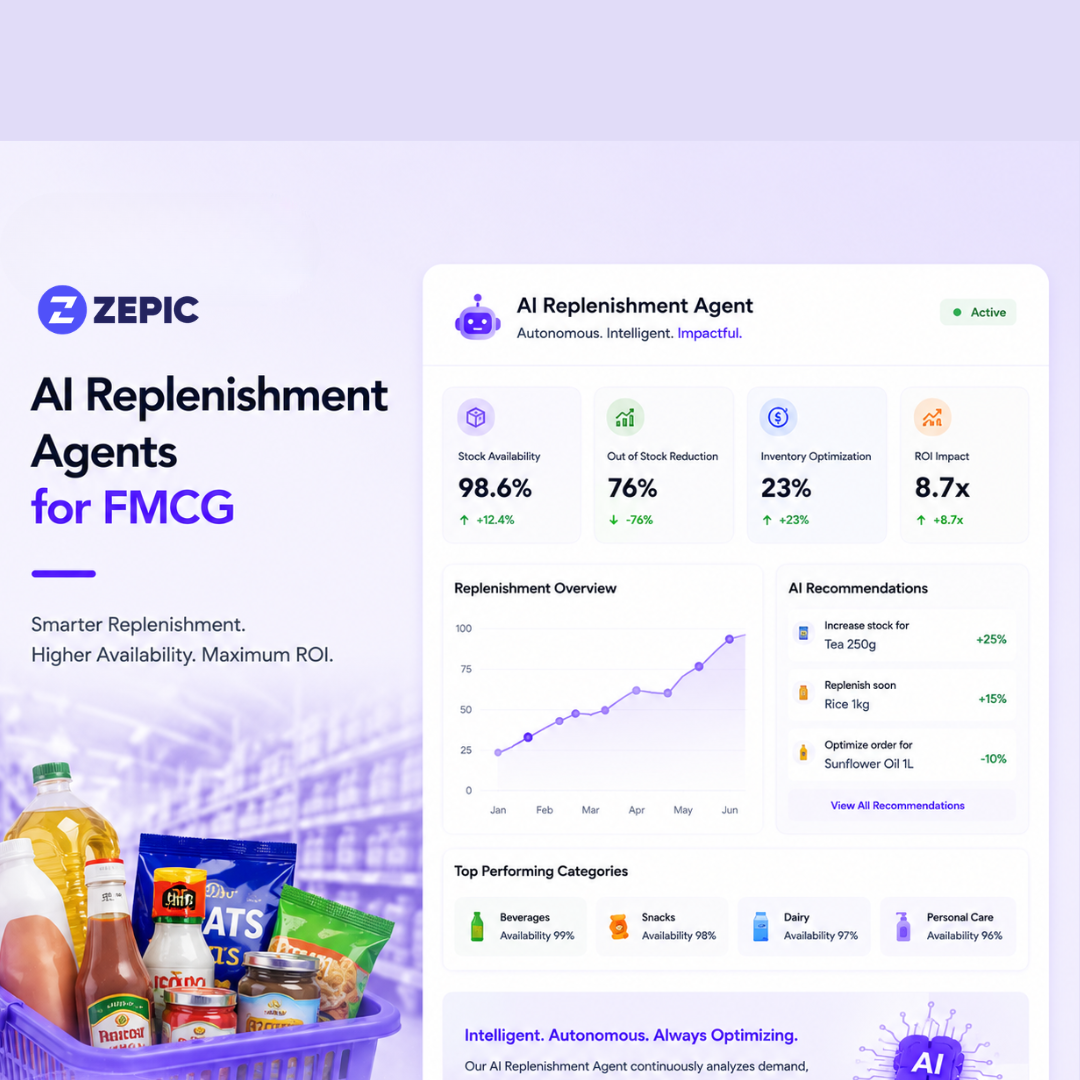
TLDR:
Grocery and FMCG brands operate on some of the thinnest margins in retail, typically below 10%. In a sector where a 1% swing in procurement costs or logistics efficiency hits the P&L directly, there is very little room for inefficiency.
And yet, the industry bleeds money at a predictable, documented, and largely preventable point: running out of stock.
Out-of-stock situations cost FMCG retailers $82 billion in missed sales in a single year, according to NielsenIQ. Empty shelves cost U.S. retailers $1.4 billion in lost FMCG sales each week. Grocery retailers have out-of-stock rates of 7 to 10% worldwide. And when a product is missing, 46% of those customers simply do not buy it, meaning the sale is gone, and in many cases, so is the customer.
AI replenishment agents do this continuously, without human scheduling cycles or manual review.
For a category operating on sub-10% margins, that is a very large return on a very focused investment.
Stockouts are not a mystery; they are caused by various factors like inaccurate demand forecasting, promotional spikes that catch replenishment cycles off guard, supplier delays, and systems that react to shortages rather than predicting them.
What makes stockouts so costly in grocery and FMCG specifically is the compounding effect. A shopper who cannot find their preferred brand does not usually wait. They switch to a competitor.
Research from the University of Colorado and IE Business School Madrid shows that when an out-of-stock leads to the purchase of a competing brand, that trial frequently becomes a permanent switch. A typical retailer loses around 4% of total sales to stockouts, which translates to an earnings-per-share loss of $0.012 for every dollar of average EPS, a significant erosion in a sector where EPS is already thin.
The flip side is equally damaging: overstocking perishables creates waste, ties up working capital, and forces markdowns that erode margins further.
So, the solution is to get exactly the right amount of stock. This precision is what AI replenishment agents deliver.
An AI replenishment agent is not a smarter version of a spreadsheet or a slightly improved reorder rule. It is a system that reasons continuously across multiple data streams to make and execute inventory decisions in real time.
Here is what that looks like in practice:
Demand forecasting at the SKU level: Rather than forecasting by category or product family, the agent forecasts demand for each individual SKU, factoring in historical sales velocity, day-of-week and time-of-year patterns, local events, weather, and promotional calendars. A spike in demand for barbecue products ahead of a July 4th weekend in a suburban market is predicted and prepared for, not discovered after the shelves are empty.
Automated reorder triggering: When stock levels approach a defined threshold, the agent generates a reorder recommendation or, in more advanced implementations, places the purchase order directly with the supplier. No human has to review a report and initiate the process. The cycle time from signal to action shrinks from days to minutes.
Supplier integration: The agent connects to supplier portals to check lead times, confirm availability, and log the transaction, without someone manually logging into a portal, copying data, and updating an ERP record. McKinsey data shows AI-driven automation can cut logistics costs by 5 to 20% and save 5 to 15% on procurement spend, largely by eliminating this friction.
Promotional and event sensitivity: The out-of-shelf rate doubles when products are on promotion. An AI agent that knows a promotion is scheduled can adjust reorder quantities and timing in advance, rather than scrambling when a campaign drives unexpected velocity.
Cross-location balancing: For brands and retailers with multiple distribution centers or store locations, the agent identifies stock imbalances across the network and triggers redistributions before individual locations go out of stock.
Grocery and FMCG are not industries where technology investments get approved on hope. The ROI case for AI replenishment is built on documented operational outcomes:
Walmart reports sales grew nearly 5% while inventory rose only 2.6%, attributing the divergence to automation, which points to smarter forecasting and replenishment at scale. That ratio, growing sales while keeping inventory lean, is exactly the outcome AI replenishment agents are designed to produce.
The ROI case is not only on the operational side. Consumer appetite for AI-assisted grocery replenishment is measurable and growing.
32.6% of shoppers say they are likely to let AI reorder staple items when supplies run low, according to a July 2025 EMARKETER and Amazon Ads survey. 45.8% say they would use an in-app chatbot that suggests meals and fills their cart. And 51% say it is important that their grocery apps offer personalized offers.
Nearly half of consumers, 47.7%, expect their comfort with AI-powered grocery tools to increase over the next five years.
That is a majority of shoppers moving toward a model where they expect the grocery platform to handle routine replenishment for them. The brands and retailers that build this experience now will capture that loyalty before competitors do.
Walmart has invested heavily in AI to refine its supply chain and inventory systems, with shelf-scanning robots in stores and machine learning tools tracking stock levels in real time. AI helps Walmart plan replenishments with precision, optimize warehouse space, and reduce waste, especially in the grocery segment where freshness is critical.
Walmart is also utilizing an AI agent to help merchants identify causes of supply management issues, moving from reactive problem-solving to proactive detection. Separately, Walmart's Marty agent helps suppliers analyze performance and manage replenishment decisions at the supplier level, not just at the retailer.

Through integration with OpenAI's Operator, customers can now place full grocery orders through Instacart using natural language, with requests like "I'm having an Italian-themed party; get me a linguine and clams recipe and fill my Instacart cart with what I need." The operator acts autonomously, curating the shopping list and placing the order, without the customer managing any of it.
For grocery brands, this is the consumer-facing expression of the same underlying trend: AI handling the routine, repetitive parts of the grocery relationship so the customer does not have to think about it.
Supply-side replenishment AI focuses on the operational layer: forecasting, automated ordering, supplier coordination, warehouse stock positioning, and markdown reduction. This is where the McKinsey cost reduction numbers come from and where most enterprise FMCG deployments start.
Consumer-facing replenishment AI is the shopper-side expression of the same intelligence. It surfaces a "reorder your usual" prompt to a shopper whose purchase frequency predicts they are running low on it. It builds a weekly basket from meal plan inputs. It sends a nudge when a staple is on promotion. It handles subscription management for recurring purchases without requiring the shopper to think about it.
Both applications feed each other. Consumer-side replenishment data makes supply-side forecasting more accurate because revealed purchase intent is a better demand signal than historical shipment data alone. And supply-side accuracy makes consumer-side replenishment reliable, because you can only confidently tell a shopper to auto-reorder if you know the product will actually be available.
The implementation path does not require overhauling existing ERP or supply chain systems in one go. Most brands see the fastest ROI by starting narrow and expanding:
Step 1: Identify your highest-velocity SKUs. These are the products where stockouts cause the most immediate revenue loss and where demand patterns are most predictable. Starting with a defined set of SKUs lets you validate the agent's forecasting accuracy before expanding coverage.
Step 2: Connect real-time POS data. AI replenishment is only as good as the demand signals it receives. Real-time point-of-sale data, rather than weekly batch uploads, is what enables the agent to catch demand shifts before shelves empty.
Step 3: Integrate supplier lead time data. Reorder decisions that account for actual lead times, not assumed ones, reduce both stockouts and overstock. Most suppliers have this data available via API or portal. The agent needs it to optimize timing.
Step 4: Build the consumer-side trigger. Once operational replenishment is running, the consumer-facing layer is the natural next step. Connecting purchase frequency data to personalized reorder prompts in your app or email channel creates a retention flywheel: the shopper stops thinking about restocking, and the brand owns that recurring relationship.
Step 5: Measure against five metrics. In-stock rate, inventory turnover (Days Sales of Inventory), forecast accuracy, logistics cost per unit, and consumer-side replenishment conversion rate. These five tell you the full picture of what the agent is doing for your business.
Grocery and FMCG brands operate in a sector where growth is measured in single-digit percentages. A 20 to 30% reduction in inventory carrying costs is not a rounding error in that context. It is a structural improvement in the economics of the business.
According to McKinsey, AI-driven automation can reduce inventory levels by 20 to 30% and cut logistics costs by 5 to 20% while saving 5 to 15% in procurement spend. On a revenue base of $100 million, those numbers represent meaningful improvement.
The global AI in FMCG market is projected to reach $57.7 billion by 2033, growing at a 22% CAGR. The companies capturing that market are not experimenting. They are deploying AI replenishment into production workflows and compounding the advantage with each passing quarter.
The cost of doing nothing is not zero. Every week of stockout on a high-velocity SKU is a week of lost sales, potential permanent brand switching, and a competitor getting trial they would not otherwise have earned. At $1.4 billion in weekly FMCG out-of-stock losses across US retail, even capturing a fraction of your proportional share of that recovery is a significant number.
AI replenishment agents represent the clearest ROI case in the grocery and FMCG technology stack right now. The problem they solve is well-documented and expensive. The technology is proven in production at Walmart, Kroger, Sprouts, and across RELEX's 700-plus customer base. The consumer appetite for AI-assisted replenishment is already at 32.6% and growing.
The question is not whether to invest in this capability. It is how quickly you want to start compounding the benefit.
ZEPIC helps grocery and FMCG brands build AI-powered customer and operational experiences that drive measurable ROI. Talk to our team.

%201.png)



.jpg)
.jpg)


