Meet

Neura HQ,
Your connected AI Agent Workforce Know more



TLDR:
Every year, millions of shoppers land on a D2C brand's website with money to spend and a clear mission: find a gift for someone they care about. And every year, the vast majority of them leave without buying anything.
Not because your product was wrong or the price was off, but because finding the right gift for someone else is genuinely hard, and most D2C brands give shoppers almost no help doing it.
A generic search bar and a "bestsellers" section are more of a product catalog that’s helpful for gift shopping.
This is where AI gift recommendation agents come in. They turn the notoriously high-friction gifting journey into a guided, personalized conversation that ends in a purchase. And the revenue opportunity attached to that shift is enormous.
The global gift retailing market was valued at $491.82 billion in 2025 and is projected to grow to $678.08 billion by 2034 at a 3.64% CAGR. The personalized gifts market alone is projected to reach $138.17 billion by 2030, growing at 12.97% annually from 2024.
And yet, most of this spending happens despite a genuinely painful shopping experience.
Two-thirds of Americans say they struggle to find the perfect gift. Gift shoppers face a unique problem that regular shoppers do not: they are buying for someone else, which means they have to remember another person's preferences while navigating a catalog they may not know well, under time pressure, often without much help.
The friction shows up in the numbers:
Gift shopping, with its inherent complexity and emotional stakes, is at the worst end of that abandonment curve. An AI gift recommendation agent is purpose-built to solve exactly that problem.
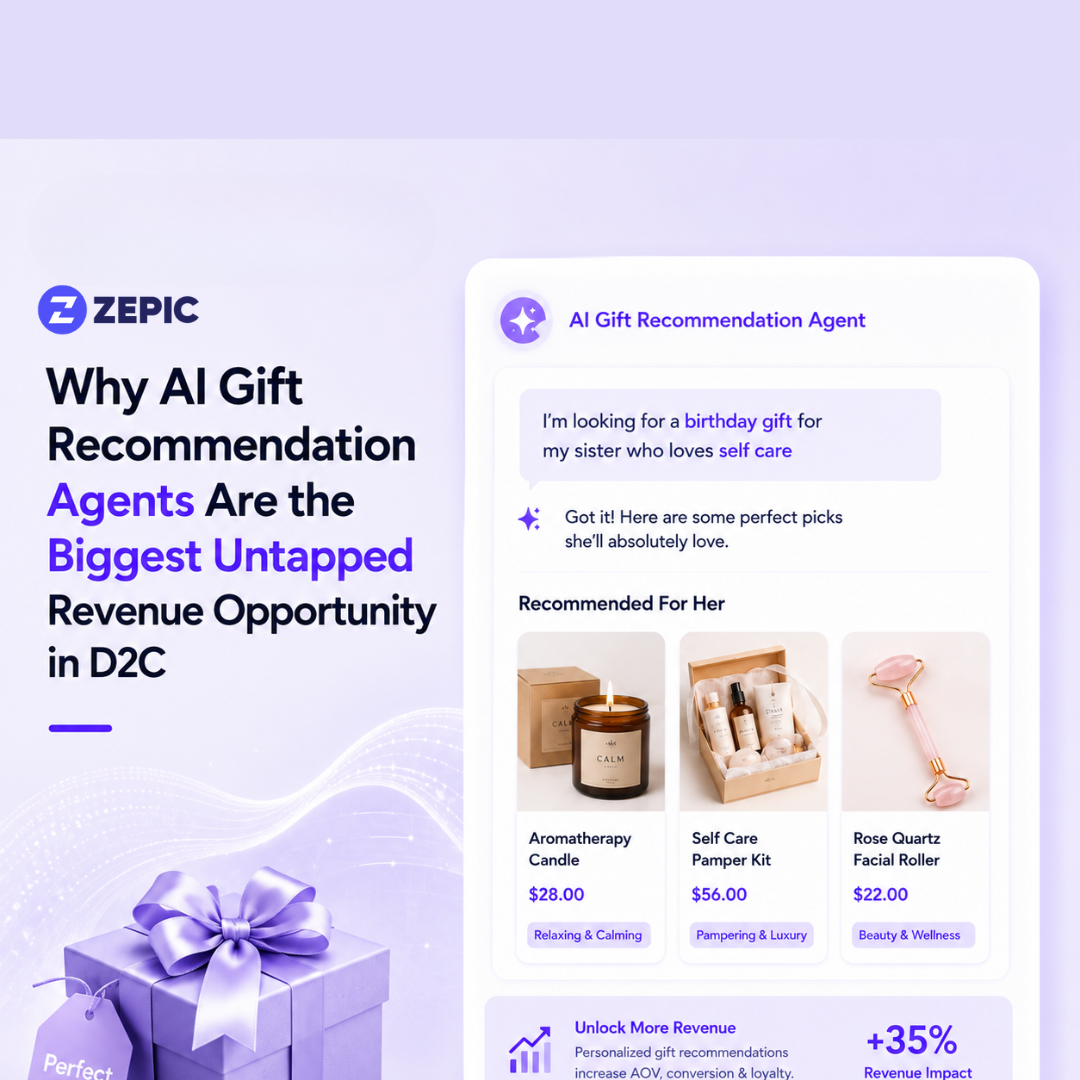
A gift recommendation agent is an AI-powered conversational tool designed to guide a shopper through the entire gifting journey, from "I have no idea what to get" to checkout, without requiring them to browse, filter, or guess.
Here is what the interaction looks like in practice:
A shopper lands on your site. Instead of staring at a product grid, they are greeted with "Who are you shopping for today?" They type, "My dad's 60th birthday; he likes golf and cooking. The budget is around $100."
The agent interprets the occasion, interests, age context, and budget. It returns a curated selection of two or three relevant products with a short explanation of why each one fits. The shopper picks one, adds it to the cart, and checks out.
The whole exchange takes under two minutes. Beyond the basic use case, a well-built gift agent can also:
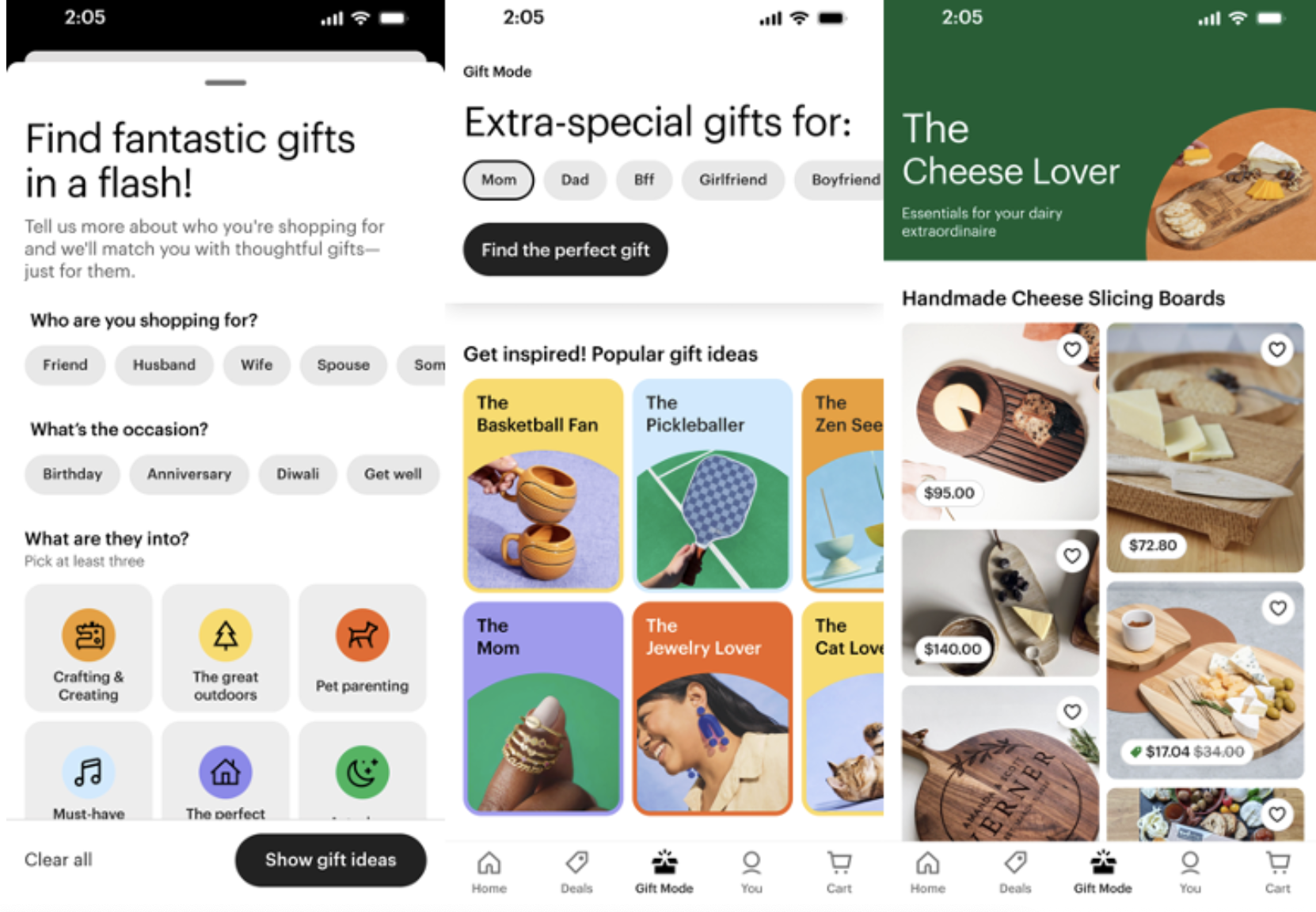
Etsy launched Gift Mode using a combination of machine learning, human curation, and GPT-4, reflecting a collection of over 200 gift recipient personas and 100 million products. The gift guides are segmented into personas such as "The Self-Care Enthusiast" and "The Foodie," with Etsy planning to introduce new personas based on emerging trends.
Etsy's catalog is enormous and diverse. Without a guided gifting experience, most visitors leave without finding anything specific enough to feel like a real gift. Gift Mode converts that browsing intent into a structured, personalized shopping journey. Etsy also added a Gift Teaser feature that lets buyers send a preview of the gift to the recipient via email, reducing the friction of gifting for experiences or delayed deliveries.
Target's app launched an AI-powered gift finder for the 2025 holiday season that responds to prompts, including the recipient's age and specific hobbies, then returns relevant product suggestions. It is an occasion-specific tool built for exactly the high-stakes, time-pressured moments when shoppers need the most help and have the least patience for browsing.
OpenAI launched Operator, an agentic AI tool that can complete tasks like finding a gift on a partner's website. Etsy was one of the launch partners, with OpenAI citing the use case: "ordering a personalized enamel mug on Etsy while booking a campsite on Hipcamp." This demonstrates the direction the space is heading: gifting as a task that AI agents can handle autonomously, from discovery through to checkout, across multiple platforms simultaneously.
Amazon Rufus can handle occasion-based queries like "what is the best gift for Valentine's Day" or "best dinosaur toys for 5-year-olds," generating tailored results across Amazon's full catalog. With Rufus now handling over 250 million users and driving 60% higher conversion rates among active users, the gifting use case is one of its most natural applications. For D2C brands, the implication is clear: if Amazon is meeting gifting intent with an AI agent and you are not, you are sending shoppers straight to them.
Mass retail platforms like Amazon and Target have the catalog breadth. But D2C brands have something those platforms cannot match: deep product knowledge, strong brand identity, and direct customer relationships.
An AI gift agent built on those advantages can do things a marketplace agent cannot:
Curate with authority: A skincare D2C brand's agent does not just know the products. It knows which ones make the best gifts for which skin types, which ones photograph well for gifting, and which ones carry the emotional weight of feeling premium and considered. That expertise cannot be replicated by a generic AI trained across millions of products.
Connect to first-party data: About 60% of D2C revenue comes from returning customers, and loyal customers convert at 60 to 70% compared to 5 to 20% for new prospects. A gift agent connected to your customer data knows that the person shopping today bought a product for their partner last Valentine's Day. It can avoid recommending the same thing. It can escalate to something more premium. It can personalize in ways a marketplace cannot.
Own the occasion relationship: When a brand's gift agent helps a shopper find the perfect present, the brand gets credit for that experience. The shopper remembers not just the product but the ease and thoughtfulness of how they found it. That is a retention driver that compounds over time.
Build gifting into retention: The gifting moment creates a natural handoff to the recipient. A beautifully packaged D2C product that lands with the right gift experience often converts the recipient into a new customer. An AI gift agent, when tied to post-purchase flows, can facilitate that conversion systematically.
Conversion rates go up: AI-powered personalization can boost conversion rates by up to 23% through real-time user behavior analysis. For gifting shoppers specifically, who are already motivated to buy but blocked by indecision, that lift tends to be higher because the agent removes the core friction: not knowing what to choose.
Average order value increases: Gift agents naturally surface bundles, gift sets, and complementary add-ons as part of the guided experience. A shopper who came in for a single item often leaves with a packaged set or an added card and wrap option. AI personalization can generate revenue increases up to 40%, with fast-growing companies deriving 40% more revenue from personalization than slower-growing peers.
Cart abandonment drops: The guidance the agent provides reduces the "I'll think about it" moment that causes abandonment. When a shopper has already made the right choice, there is much less reason to leave and come back later, or not come back at all.
New customer acquisition improves: Gift recipients who receive D2C products and have a positive unboxing experience represent a warm acquisition opportunity. An agent that captures the recipient's email with a gift preview feature (as Etsy does) or a "share this gift" mechanic creates a structured path from gift to new customer.
You do not need a massive engineering team or a six-month roadmap. Most D2C brands can deploy a focused AI gift recommendation experience with three building blocks in place.
Step 1: Clean, gifting-oriented product data: Tag your products with occasion types (birthday, anniversary, housewarming), recipient profiles (for him, for her, for parents, for colleagues), and price tiers. The agent can only make relevant recommendations if the underlying metadata supports it.
Step 2: A gifting entry point: Create a clear path into the gift experience, a prominent "Find a Gift" button, a seasonal gift guide landing page, or a chat trigger that launches when a visitor lands on a gifting-adjacent page. Do not make shoppers hunt for the experience.
Step 3: Connect your customer data: An agent that knows what a repeat customer has bought before gives better recommendations than one starting from scratch. Your CDP is the differentiator. Feed the agent with purchase history, browsing behavior, and any stated preferences.
From there, you measure return rate on gifted products, AOV for sessions that go through the agent versus those that do not, repeat purchase rate from gift recipients, and occasion-triggered open and conversion rates. Those four metrics tell you everything you need to know about whether the agent is working and where to improve it.
The global personalized gifts market is growing at nearly 13% annually and is projected to more than double between 2024 and 2030. At the same time, major retailers like Walmart, Target, and Amazon are deploying AI gift finders for the holiday season, building consumer familiarity with guided AI gifting experiences.
That familiarity is important. As consumers grow accustomed to AI-guided gifting at mass retail, their expectations will carry over to the D2C brands they shop with. The brands that build this experience now will meet that expectation when it arrives. The brands that wait will be playing catch-up in a channel where consumer habits are already forming.
The average D2C brand retains just 28.2% of customers for a second purchase, meaning nearly three out of four first-time buyers never come back. Gifting is one of the highest-intent, highest-emotion entry points into a brand relationship. An AI gift agent that turns that moment into a memorable experience is one of the most efficient retention investments a D2C brand can make.
The shoppers are there. The budget is real. The technology is ready. The only thing missing is the experience to meet them with.
ZEPIC helps D2C brands build AI-powered customer experiences that convert first-time visitors into long-term customers. Talk to our team about building your AI agent.

%201.png)



.jpg)
.jpg)


