TLDR:
- AI shopping agents are replacing chatbots by using LLMs to understand intent, context, and take actions
- Key capabilities include multi-step reasoning, memory, cross-channel continuity, and autonomous actions
- These agents can search products, filter options, apply discounts, and even complete purchases
- AI-assisted shoppers convert ~4x higher (12.3% vs 3.1%) and buy faster
- AI-driven recommendations increase average order value by 15–21%
- AI commerce is growing rapidly, expected to reach $22.6B by 2032
- Major players like Amazon (Rufus) and Walmart (Sparky) are already seeing massive adoption and revenue impact
- Smaller brands can also adopt AI agents using accessible tools for specific use cases (e.g., product finder, returns automation)
- Success depends on 4 pillars: clean product data, strong personalization (CDP), GEO (AI-friendly content), and focused use cases
- Challenges include low consumer adoption (still early), trust issues, and unclear attribution models
- The shift to agentic commerce is inevitable—brands that adopt early will gain a major competitive edge
Remember the last time a website chatbot actually helped you? We’re not talking about looping you through a decision tree or handing you off to a human. We’re talking about a time when it actually understood what you meant and moved you closer to buying.
For most shoppers, that memory is hard to recall, because for the better part of a decade, chatbots were basically glorified FAQ pages. However, that era is ending fast.
The chatbot wave actually delivered scripted menus, frustrating loops, and zero memory. Ask it something outside its decision tree, and you'd get a polite non-answer or an instant handoff to a human.
Brands deployed them because they promised cost savings. Even though some of those savings were real, the customer experience was almost universally mediocre. Shoppers learned quickly that chatbots weren't worth engaging with, and click-through rates reflected that.
The core problem was that rule-based chatbots were reactive and rigid. They could only follow a path someone had pre-programmed. They had no understanding of intent and no ability to reason across multiple steps.
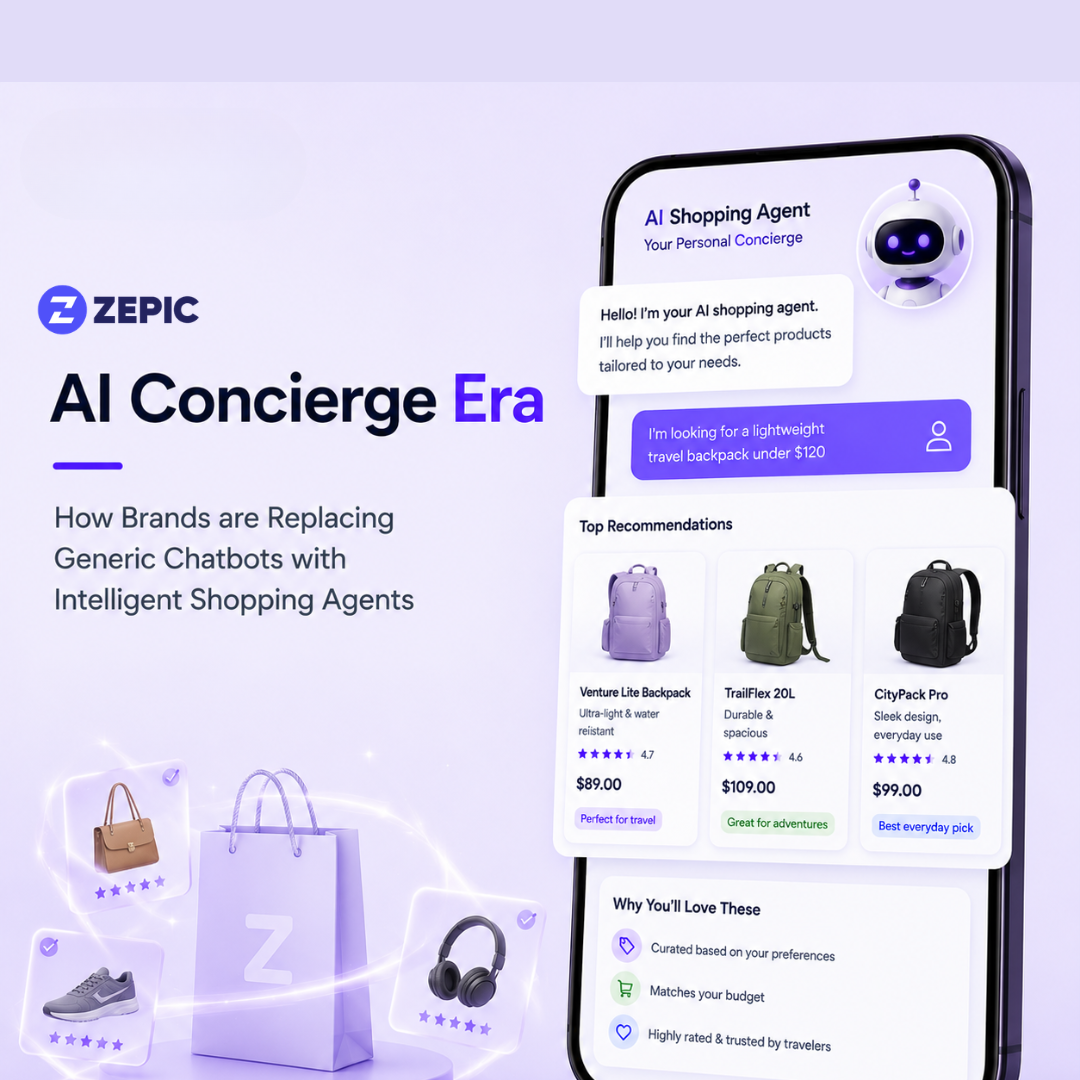
That’s why many brands are now deploying AI shopping agents that can understand context, remember preferences, handle multi-step tasks, and, in some cases, complete a purchase entirely on their own.
Here is what is actually happening, why it matters, and what your brand needs to do about it.
How is an AI Shopping Agent Different from a Chatbot
An AI shopping agent uses a large language model (LLM) to understand natural language, reason across multiple steps, remember context, and take action inside your systems. Instead of following a script, it interprets what the shopper is trying to accomplish and figures out how to get them there.
Let’s look at a few capabilities that separate AI shopping agents from chatbots:
- Multi-step reasoning: A shopper says, "Find me a moisturizer for dry skin under $40 that ships by Friday." The agent breaks that into sub-tasks, checks inventory, filters by price, checks shipping times, and returns a curated answer.
- Memory and continuity: The agent remembers what was discussed earlier in the session (and potentially across sessions), so the shopper does not have to repeat themselves.
- Autonomous action: Advanced agents can add items to carts, apply discount codes, process returns, and complete checkout, all within a single conversation.
- Cross-channel context: The same agent can follow a customer from web chat to email to WhatsApp without losing the thread.
Here’s How AI is Transforming Shopping
The data coming in from early deployments is hard to argue with.
Conversion is the headline metric:
- Shoppers who engage with AI during a session convert at 12.3%, nearly four times the 3.1% rate of those who do not, according to Rep AI's 2025 Shopper Behavior Report analyzing over 17 million shopping sessions.
- Visitors arriving from generative AI sources during the 2025 holiday season converted 31% higher than traffic from traditional channels.
- Generative AI traffic to U.S. retail sites grew 4,700% year-over-year as of July 2025.
Average order value goes up too:
- AI-driven recommendation engines consistently deliver 15 to 21% higher average order values, according to research compiled by Alhena AI.
- Shoppers using AI complete purchases 47% faster, per data aggregated by Shopify.
The market is moving at speed:
- The AI-enabled ecommerce market is valued at $8.65 billion in 2025 and projected to reach $22.6 billion by 2032 at a 14.6% CAGR (Anchor Group Research / NVIDIA).
- McKinsey projects agentic AI will influence $3 to $5 trillion in global retail commerce by 2030.
- According to Gartner, 33% of enterprise software applications will include agentic AI by 2028, up from under 1% today.
How Major Brands are Using AI Shopping Agents
Amazon Rufus
Amazon's AI shopping assistant Rufus launched in early 2024 and by the end of 2025 had reached 250 million users, with monthly active users up 149% and interactions up 210% year-over-year (Amazon Q3 2025 earnings call).
The numbers it is driving are significant. CEO Andy Jassy confirmed Rufus is projected to generate over $10 billion in incremental annualized sales. Customers who engage with Rufus during a shopping trip are 60% more likely to complete a purchase compared to those who don't.
Amazon trained Rufus on its entire product catalog, customer reviews, community Q&As, and web data, turning it into a context-aware shopping companion rather than a simple search tool.
Walmart Sparky
Walmart took a different route by partnering with OpenAI to build Sparky, giving it access to the most advanced models without building from scratch. The result is a conversational assistant that offers product recommendations, summarizes reviews, and handles a range of shopping tasks within the app.
By fall 2025, 81% of surveyed Walmart customers reported using Sparky to check product availability and review specifications before buying, according to Walmart's own internal survey data. Walmart also integrated ChatGPT's Instant Checkout into Sparky, allowing customers to complete purchases within the chat interface in a single tap for returning users.
Walmart's automated fulfillment centers supported by AI have already cut unit costs by 20% compared to manual sites.
What This Means for Everyone Else
Amazon's and Walmart's scale are unique, but the playbook is not. Smaller and mid-market brands are deploying purpose-built AI agents for specific use cases: personalized product finders, reorder automation, bundle builders, and post-purchase support agents. The infrastructure to do this, through platforms and APIs, is increasingly accessible.
The Four Pillars of an AI Shopping Agent Strategy
If you are thinking about what this looks like in practice for your brand, the architecture breaks down into four areas:
1. Product Data Quality: AI agents can only surface what they can read. Clean, structured product data with full-sentence descriptions, complete attribute tagging, and accurate inventory signals is the foundation. Poorly structured catalogs produce poor recommendations, regardless of how good the underlying model is.
2. Personalization Infrastructure: The agent layer needs to connect to behavioral data to be useful. If the agent cannot see purchase history, browsing behavior, or segment data, it resorts to generic recommendations, which defeats the purpose. Your customer data platform (CDP) needs to feed the agent in real time.
3. Generative Engine Optimization (GEO): As more product discovery happens through AI agents rather than traditional search, the optimization game changes. Brands need indexable review sections, clear metadata, FAQ-style product descriptions, and content structured for how AI agents retrieve and surface information, not just how search engines index keywords.
4. Scope Before You Scale: The brands seeing the best early results are narrowing down on specific AI agent use cases. Here are some examples:
- A returns automation agent.
- A product finder for a single category.
- A reorder assistant for high-frequency buyers.
These contained deployments generate real data, build internal competency, and create a foundation for broader rollout.
What to Watch Out for
Consumer adoption is still early. A YouGov study from July 2025 found that while 43% of consumers have heard of AI shopping agents, only 14% have actually used one. The technology is ahead of behavior change, which means brands need to actively drive discoverability and adoption rather than assuming shoppers will find it on their own.
The attribution picture is murky: As third-party AI agents like ChatGPT and Perplexity drive traffic and influence purchases, traditional attribution models break down. Amazon filed a federal lawsuit against Perplexity AI in November 2025 over unauthorized AI agents accessing its platform. The retailer-agent relationship is still being defined, and brands need clear data strategies before that landscape settles.
Brand control requires intentional design: An agent that hallucinates product details or recommends the wrong item is worse than no agent at all. Brand-trained, catalog-grounded agents with guardrails and human escalation paths are not optional; they are the standard to build toward.
The trust gap is real. 71% of consumers say they are frustrated by impersonalized shopping experiences (EComposer, citing multiple survey sources), but 87% still prefer a hybrid model that combines AI efficiency with human empathy (Shopify / NVIDIA data). Agents need to know when to hand off, not just when to close.
What This Means for Your E-commerce Brand in 2026
The shift from chatbot to AI shopping agent is a structural change in how consumers discover and buy products. The data is consistent across sources: AI-assisted shoppers convert more, spend more, and buy faster.
The question for marketing and e-commerce teams is not whether this shift is happening. It already is. The question is how quickly you want to build a position in it.
A few things to act on now:
- Audit your product data: If your catalog is messy, fix it before you build anything. The agent is only as good as what it can access.
- Define one high-value use case: Reorder automation, a product finder, cart recovery—pick one with a measurable outcome and build it well.
- Connect your CDP to the agent layer: Personalization without behavioral data is just educated guessing.
- Track AI-referred traffic separately: Start building a baseline now so you can measure what is working as the channel grows.
The brands that treat agentic AI as a core commerce channel, rather than a chatbot upgrade, will own the next wave of customer relationships. The window to be an early mover is narrow, and it is closing.
We are working on something exciting at ZEPIC. If you're thinking about deploying AI agents, talk to our team.
Frequently Asked Questions
What is an AI shopping agent?
An AI shopping agent is a software program powered by a large language model that can understand natural language, reason across multiple steps, and take actions on behalf of a shopper. Unlike traditional chatbots, it does not rely on fixed decision trees. It can search product catalogs, filter options, recommend products, and in advanced cases complete purchases within the same interface.
What is agentic commerce?
Agentic commerce refers to a shift in online shopping where AI agents handle product discovery, comparison, and purchasing on behalf of users. Instead of manually browsing multiple websites, shoppers can instruct an agent to find, compare, and buy products within a single conversational interface.
Can AI agents actually complete purchases automatically?
Yes, in certain implementations. AI systems can already complete the entire pre-purchase journey and, in some cases, process payments within the same interface. However, fully autonomous purchasing without user confirmation is still evolving. Many current systems operate with a one-tap checkout or require final approval before completing transactions.
Which brands are already using AI shopping agents?
Major retailers have already deployed AI shopping assistants. These include platforms like Amazon, Walmart, Target, Instacart, and Shopify-based brands. In addition, niche startups are building specialized agents focused on use cases such as price comparison or influencer-led product discovery.
Do consumers actually trust AI shopping agents?
Consumer trust in AI shopping agents is growing, but not universal. A significant portion of shoppers already use AI tools for product discovery and plan to increase usage. However, concerns around data privacy and payment security remain, making transparency, compliance, and human fallback options critical for adoption.
How do AI shopping agents improve conversion rates?
AI agents improve conversion rates by reducing friction, delivering real-time personalization, and maintaining conversational continuity. Shoppers receive instant, relevant recommendations without navigating multiple pages. This leads to significantly higher conversion rates compared to traditional ecommerce experiences.
What is the future of AI in retail shopping?
The future of retail is shifting toward AI-driven discovery and purchasing. AI agents will handle more of the end-to-end journey, while product discovery increasingly moves from brand websites to AI interfaces. Brands that invest in structured product data and agent-compatible systems will gain visibility, while others risk becoming invisible in this new discovery layer.
Desperate times call for desperate Google/Chat GPT searches, right? "Best Shopify apps for sales." "How to increase online sales fast." "AI tools for ecommerce growth."

Been there. Done that. Installed way too many apps.
But here's what nobody tells you while you're doom-scrolling through Shopify app reviews at 2 AM—that magical online sales-boosting app you're searching for? It doesn't exist. Because if it did, Jeff Bezos would've bought (or built!) it yesterday, and we (fellow eCommerce store owners) would all be retired in Bali by now.
Growing a Shopify store and increasing online sales isn’t easy—we get it. While everyone’s out chasing the next “revolutionary” tool/trend (looking at you, DeepSeek), the real revenue drivers are probably hiding in plain sight—right there inside your customer data.
After working with Shopify stores like yours (shoutout to Cybele, who recovered almost 25% of their abandoned carts with WhatsApp automation), we’ve cracked the code on what actually moves the needle.
Ready to stop app-hopping and start actually growing your sales by using what you already have? Here are four fixes that will get you there!
Fix #1: Convert abandoned carts instantly (Like, actually instantly)
The Painful Truth: You're probably losing about 70% of your potential sales to cart abandonment. That's not just a statistic—it's real money walking out of your digital door. And looking for yet another Shopify app for abandoned cart recovery isn't going to fix it if you're not getting the fundamentals right.
The Quick Fix: Everyone knows you need multi-channel recovery that hits the sweet spot between "Hey, did you forget something?" and "PLEASE COME BACK!" But here's the reality—most recovery apps are a one-trick pony. They either do email OR WhatsApp, not both. And don't even get us started on personalizing offers based on cart value—that usually means toggling between three different dashboards while praying your apps talk to each other.
Enter ZEPIC: This is where we come in. With ZEPIC's automated Flows, you can:
Launch WhatsApp recovery messages (with 95% open rates!)
Set up perfectly timed email sequences (or vice versa)
Create personalized recovery offers not just on cart value but based on your customer’s behavior/preferences
Track and optimize everything from one dashboard

Fix #2: Reactivate past customers today
The Painful Truth: You're probably losing about 70% of your potential sales to cart abandonment. That's not just a statistic—it's real money walking out of your digital door. And looking for yet another Shopify app for abandoned cart recovery isn't going to fix it if you're not getting the fundamentals right.
The Quick Fix: Everyone knows you need multi-channel recovery that hits the sweet spot between "Hey, did you forget something?" and "PLEASE COME BACK!" But here's the reality—most recovery apps are a one-trick pony. They either do email OR WhatsApp, not both. And don't even get us started on personalizing offers based on cart value—that usually means toggling between three different dashboards while praying your apps talk to each other.
Enter ZEPIC: This is where we come in. With ZEPIC's automated Flows, you can:
Launch WhatsApp recovery messages (with 95% open rates!)
Set up perfectly timed email sequences (or vice versa)
Create personalized recovery offers not just on cart value but based on your customer’s behavior/preferences
Track and optimize everything from one dashboard

Offering light at the end of the tunnel is Google’s Privacy Sandbox which seeks to ‘create a thriving web ecosystem that is respectful of users and private by default’. Like the name suggests, your Chrome browser will take the role of a ‘privacy sandbox’ that holds all your data (visits, interests, actions etc) disclosing these to other websites and platforms only with your explicit permission. If not yet, we recommend testing your websites, audience relevance and advertising attribution with Chrome’s trial of the Privacy Sandbox.
Top 3 impacts of the third-party cookie phase-out
Who’s impacted
How
What next
Digital advertising and
acquisition teams
Lack of cookie data results in drastic fall in website traffic and conversion rate
Review all cookie-based audience acquisition. Sign up for Chrome’s trial of the Privacy Sandbox
Digital Customer Experience
Customers are not served relevant, personalised experiences: on the web, over social channels and communication media
Multiply efforts to collect first-party customer data. Implement a Customer Data Platform
Security, Privacy and Compliance teams
Increased scrutiny from regulators and questions from customers about data storage and usage
Review current cookie and communication consent management, ensure to align with latest privacy regulations